
Matthew Heller Turns Devotion Into Demolition on “Steamroller”
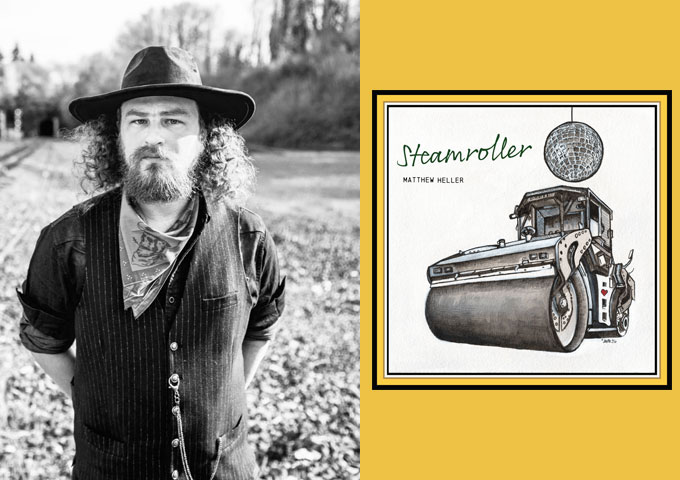
A rising indie-folk-punk voice returns with a single that treats love like weather, not decoration. Recorded at Heller High Water Studios and built on horns, guitars, and momentum, the track refuses to sit still. Heller trades comfort for candor, tracing what happens when affection curdles into dependency. The result is a song about surrender that never once feels soft. It is Matthew Heller at his most physical, and his most honest.
There is a particular kind of songwriter who treats a metaphor like a dare, picking an image so blunt it could crush the whole song if handled carelessly, then building something delicate and devastating on top of it anyway. Matthew Heller is that kind of songwriter, and his new single “Steamroller” is the proof.
Released on August 28, 2026 through Heller High Water Records, “Steamroller” arrives as the latest chapter in an artistic project that has always lived at the intersection of folk intimacy, punk urgency, and indie rock’s willingness to let a feeling get loud. Heller’s voice has been described as honeyed and raw in equal measure, and on this track that duality is the whole engine. He sings like someone trying to stay tender about something that has already run him over.
The title does a lot of the heavy lifting before a single note plays. A steamroller is not subtle. It does not tiptoe. It flattens the ground beneath it and keeps going, indifferent to whatever shape the terrain used to be. Heller has said the image represents love as a force rather than a comfort, something that changes the landscape underneath a person whether they are ready or not. That is a bracing way to frame romance, and it is exactly why the song works. Instead of reaching for the usual language of butterflies or gentle warmth, Heller reaches for machinery, weight, and unstoppable motion.
Musically, the production leans hard into that idea. Sam Densmore, who produced and mixed the track at Heller High Water Studios, builds a soundscape wide enough to hold the metaphor. Portland horn players bring saxophone, trombone, and trumpet into the mix, threading warmth through layers of atmospheric guitar, synth, and keyboard work. A steady, driving drumbeat anchors everything, giving the arrangement the sensation of forward motion that never really lets up. It is a smart choice. A song about something unstoppable needs a rhythm section that behaves the same way, and here it does.
But the real tension in “Steamroller” lives in the lyrics, and it is more complicated than the title alone suggests. The verses are not romantic in any conventional sense. They read almost like a character study, sketching a person defined by contradiction: someone who is a good doctor and a good friend, but also a chain-smoker who leans on others too heavily. Someone described as too slow yet always rushing, too loud yet constantly hushed. It is a portrait built entirely out of opposites, which is its own kind of honesty. People rarely make sense when you love them. They are inconsistent, frustrating, magnetic, and exhausting, sometimes within the same breath.
As the verses continue, the picture sharpens into something heavier. There is imagery of someone perpetually waiting, never quite settled, caught in a cycle of wanting to be seen and fearing abandonment at the same time. Later lines gesture toward dependency, medication, and the uncomfortable admission that one person has become a crutch for another. That is a striking pivot for a song titled “Steamroller.” It suggests the destructive force in question is not just love itself, but the weight of being needed too much, or needing too much in return.
Then comes the chorus, and with it, the emotional thesis of the whole song. Heller sings about waiting a long time to realize that love behaves less like a steady structure and more like a rollercoaster, a comparison that immediately reframes the steamroller image. A rollercoaster is thrilling and disorienting. It has highs that feel euphoric and drops that feel like the floor disappearing. Placing that metaphor right next to the steamroller creates a kind of emotional whiplash, which seems intentional. Heller is not describing one feeling. He is describing the exhausting coexistence of several feelings at once: exhilaration, fear, obligation, and finally, exhaustion.
The chorus also introduces a second thread that deepens the song considerably: the search for being at home within one’s own soul. That line matters because it shifts “Steamroller” away from being purely a song about another person and toward being a song about self-recovery. The narrator is not just processing a relationship. He is trying to locate solid ground within himself after being flattened by something bigger than he expected. By the time the steamroller line returns at the end of the chorus, it no longer reads as pure romantic surrender. It reads as recognition, almost confession, the moment someone finally names the thing that has been running them over.
The bridge and later verses lean further into detachment, describing someone who is always still, always waiting, always reliant on pills and routine, someone leaned on so heavily that they become a crutch rather than a partner. When Heller admits, almost bluntly, that he does not miss this person as much as expected, the song completes its arc. What began as an anthem about being swept away by overwhelming love ends somewhere closer to relief, the quiet, complicated relief of stepping out from under something enormous and realizing you can still breathe.
That emotional complexity is what elevates “Steamroller” beyond a simple metaphor song. It would have been easy for Heller to write three minutes about love being powerful and leave it there. Instead, he lets the metaphor evolve. The steamroller starts as passion, curdles into dependency, and ends as a kind of hard-won clarity. Few songwriters let a single image carry that much emotional distance without it collapsing under its own weight, but Heller’s arrangement gives the metaphor room to breathe and change shape as the lyrics do.
The musicianship deserves real credit for sustaining that shift. Contributions from Machado M. Mijiga on saxophone, Chris Shuttleworth on trombone, and Pablo Rivarola on trumpet give the track a brassy, almost cinematic backbone, while David Priore‘s drums and Densmore’s bass, percussion, and guitar work keep the momentum steady even as the emotional content grows heavier. Justin Chase‘s guitar and keyboard textures and Paul Peresa‘s horn arrangements and Mellotron work add depth without ever cluttering the mix, and mastering by Timothy Stollenwerk at Stereophonic Mastering gives the whole thing a polished, radio-ready finish that never sacrifices its rawness.
“Steamroller” is ultimately a song about the moment when a feeling gets too big to control, and what is left standing once it finally passes through. Matthew Heller has built a career on turning that kind of emotional wreckage into something worth listening to closely, and this single continues that tradition with confidence. It does not ask listeners to admire love from a safe distance. It asks them to stand in its path and feel exactly what that costs.
OFFICIAL LINKS: SPOTIFY – INSTAGRAM – FACEBOOK – YOUTUBE – TIKTOK