Rahul Mukerji’s Mridhangit Turns Global Collaboration Into a High-Voltage Fusion Masterpiece
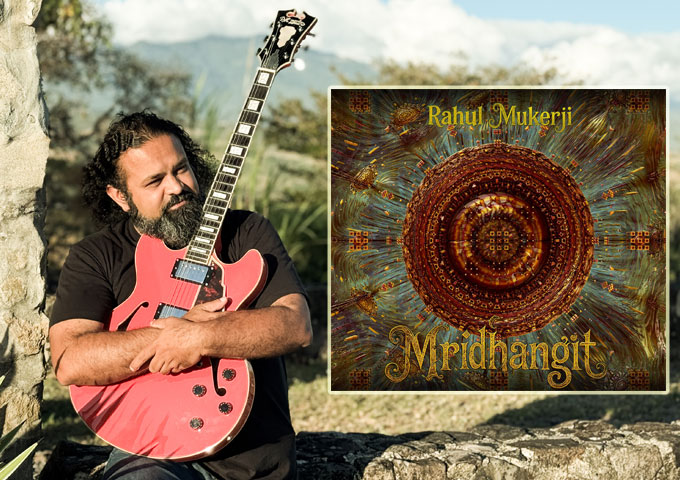
Rahul Mukerji’s Mridhangit transforms cultural distance into musical connection through an audacious meeting of Indian percussion, progressive rock, jazz, metal, fusion, funk, and cinematic composition. Conceived during the isolation of the pandemic, the album brings musicians from different continents into a remarkably cohesive instrumental conversation. Its title fuses the words mridangam, handpan, and guitar, effectively announcing the philosophy behind the entire project before the first note is heard. Across 11 tracks, Rahul Mukerji moves from ominous prog-metal textures and intricate jazz fusion to Carnatic rhythms, blues, cinematic ambience, and the mournful voice of the duduk. The result is an album that feels less like a collection of genre experiments than a living demonstration of how radically different musical traditions can speak a common language.
For Rahul Mukerji, the journey toward ‘Mridhangit’ represents a significant expansion of a creative identity already established through his debut album, Ma De Re Sha, released in 2017 and recognized with a Silver Medal at the 2018 Global Music Awards. The new record takes that foundation considerably further, earning the UnsignedOnly Music Awards Global Artist Award as well as two Global Music Awards Outstanding Achievement honors in Creativity/Originality and Composer in 2026. Those accolades provide useful context, but the most compelling evidence of the album’s ambition is contained within its music. ‘Mridhangit’ is an instrumental record with an unusually strong sense of personality, constantly shifting its vocabulary without losing sight of its central voice.
The title itself is almost a mission statement. By combining mridangam, the double-headed percussion instrument fundamental to Carnatic music, with handpan and guitar, Rahul Mukerji establishes collaboration as both technique and philosophy. The album was conceived as a way of bridging distances during a period when physical connection between musicians had become extraordinarily difficult. Rather than allowing separation to become a creative limitation, Mukerji used it as a reason to connect with players across geographical and cultural boundaries.
The collaborative nature of ‘Mridhangit’ is reinforced by its production credits. Bruce Ng and Rahul Mukerji produced the album, while Brett Caldas-Lima mixed and mastered it at Tower Studio. Proviscocity Studios handled the album artwork, concept, and layout, giving the project a visual identity alongside its musical one. At the center of the instrumental framework, Rahul Mukerji performs all guitars, while Leo Margarit performs all drums. That division of responsibilities provides a clear foundation for the album’s wide-ranging guest contributions, with each additional musician bringing a particular color or tradition into the compositions.
That architecture becomes immediately apparent with “Mr. Sinister.” The opening track begins with clean guitar, dark ambience, and distant rattling that establish an almost ritualistic atmosphere. Mukerji handles the keyboards and tabla programming in addition to all guitars, while Ruben Rubio supplies fretless bass. A bending guitar harmony gradually changes the temperature before the programmed and live rhythmic elements gather momentum. What initially feels restrained eventually erupts into groove-driven rock, dance-inflected rhythm, and full metal intensity. Slamming drums from Leo Margarit, thundering bass, and sharply articulated guitar work create a striking contrast with the track’s mysterious opening. The transition is one of the album’s first reminders that Rahul Mukerji is interested not merely in combining sounds, but in making those sounds transform one another.
“Bheja Fry” brings Indian percussion further into the foreground while retaining the aggressive personality of Mukerji’s guitar playing. Rafael Freitas handles bass, while Mukerji provides the tabla programming. Hard rock riffing sits alongside cleaner guitar textures, while blues and jazz references emerge naturally within the arrangement. The track feels like one of the clearest early statements of the album’s central aesthetic: traditional Indian rhythmic language is not placed beside Western rock as decoration, but allowed to occupy the same musical space.
That conversation develops through “Twelve Ganeshas,” where jazz becomes more prominent and the percussion architecture grows increasingly intricate. Ruben Rubio contributes bass and Praveen Sparsh performs mridangam, adding a distinctly Carnatic rhythmic voice to the composition. Full drum kit and Indian percussion coexist with carefully shaped ascending scales and reverberant clean guitar. The mood is surprisingly breezy and luminous, with the guitar phrasing recalling the elegant side of classic jazz fusion rather than its more aggressive tendencies. The track demonstrates how Mridhangit can move toward subtlety without sacrificing technical detail.
“Enjoymaddi” expands that sophistication into one of the album’s most substantial fusion statements. Maciej S performs upright bass, while Chaplin contributes piano. The track introduces lingering arpeggios, melancholy chords, and rapid scales before guitar, bass, piano, and drums gradually fill the sonic field. Leo Margarit’s drumming, Chaplin’s piano, Rahul Mukerji’s guitars, and Maciej S’s upright bass create an ensemble sound that feels simultaneously intricate and spacious. The arrangement is constantly evolving, with individual instruments emerging from the larger texture and then folding back into it. Rather than presenting virtuosity as a contest, the musicians use their technical abilities to deepen the conversation.
The title track, “Mridhangit,” shifts the emphasis toward rhythm, voice, and an especially distinctive collection of timbres. Ruben Rubio supplies bass, while Praveen Sparsh contributes both mridangam and Konnakol, the Carnatic spoken rhythmic tradition. Rahul Krishnan adds flute and tablas, while Rahul Mukerji contributes handpan alongside his guitars. Spoken vocals cut through an ambient guitar backdrop with a highly percussive delivery. As the piece develops, woodwind colors and increasingly intense drums expand the arrangement before it gradually fades. It is a fitting centerpiece because the music embodies the album’s fundamental concept: different traditions are not merely being sampled, they are interacting within the same musical architecture.
“Kalli Penn” moves into funkier territory, opening with the rhythmic presence of Ruben Rubio’s bass alongside percussion from Alejo Perezcuba. Chaplin contributes keys, while clean guitar and rapid electric leads establish a blues-rock groove. Its spirit recalls the classic fusion tradition associated with artists such as Santana, while Rahul Mukerji maintains enough rhythmic and instrumental individuality to keep the track firmly rooted in the world of ‘Mridhangit’. The combination of bass, keys, percussion, and guitar gives the piece an organic groove that contrasts effectively with the darker material surrounding it.
That energy continues with “Funky Pakora,” where jazz guitar harmonies, funky bass, keys, and full drums generate an exuberant instrumental charge. Rafael Freitas performs bass, Emi Romero contributes keys, and Dylan adds clarinet, expanding the track’s palette beyond the expected fusion instrumentation. Two guitars appear to challenge and answer each other, while the rhythmic foundation keeps the composition moving with considerable momentum. A rapid bass passage and booming drum work showcase the musicians’ technical range, while the track’s jazz character gives it an unmistakably playful personality.
With “Dushtan,” the album becomes darker again. Ruben Rubio handles bass, Chaplin provides keys, and Rahul Mukerji contributes percussion programming alongside his guitars. Thisara Bandara adds violin, introducing a striking tonal contrast to the heavier instrumental framework. Industrial ambience introduces the piece before Indian instrumental colors collide with chugging guitar and heavy drums. Phrygian tonalities deepen the ominous atmosphere, while the violin and Indian percussion add contrasting colors to the metal framework. Identified as the album’s single, “Dushtan” captures perhaps the most forceful expression of Mridhangit’s cross-cultural premise, allowing world music and heavy metal to occupy the same dramatic architecture.
“Rahu Ketu” pushes the progressive dimension even further. Ruben Rubio returns on bass, while Rahul Mukerji handles percussion programming in addition to guitar. Gentle guitar and ethnic percussion gradually give way to heavier guitar and bass lines, with the extended runtime allowing the musicians to explore several interconnected ideas. The track moves between traditional Indian influences, progressive instrumental music, and metal without treating those identities as separate compartments. Its guitar choruses possess a sweeping, almost interplanetary quality, giving the piece a sense of scale that matches its ambitious construction.
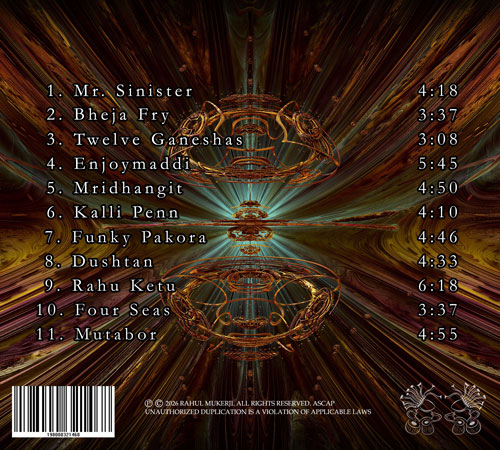
The penultimate “Four Seas” slows the pulse and returns to the expansive piano language heard earlier. Ruben Rubio supplies bass, Chaplin contributes piano, and Praveen Sparsh performs mridangam. Gentle melodies gradually accumulate percussion, full drums, and resonant bass, while the piano spreads across the register and gives the composition increasing breadth. The arrangement grows patiently rather than explosively, demonstrating another side of Rahul Mukerji’s compositional personality. Where other tracks thrive on attack and rhythmic complexity, “Four Seas” finds power through accumulation and atmosphere.
Finally, “Mutabor” brings ‘Mridhangit’ to its quietest and most contemplative destination. Erkan Erginci places the duduk at the forefront, while Rahul Mukerji supplies tabla programming and all guitars. Dramatic woodwind textures and sustained ambience create a cinematic setting before delayed guitar and tabla rhythms gradually establish a more soothing pulse. The duduk’s mournful character adds an almost elegiac quality, allowing the album to disappear rather than conclude with a conventional climax. After so much rhythmic force and instrumental density, the restraint feels deliberate and deeply effective.
What makes ‘Mridhangit’ particularly compelling is the consistency beneath its variety. The album moves through metal, jazz, funk, blues, progressive rock, Carnatic percussion, cinematic sound design, and global instrumental traditions, yet its individual components rarely feel artificially assembled. The musicians seem to understand that successful fusion is not about making every element sound identical. It is about giving contrasting elements enough space to retain their identities while finding the rhythmic, harmonic, and emotional relationships that allow them to function together.
That achievement reflects the album’s deeper creative premise. ‘Mridhangit’ explores a composition style designed to encourage non-traditional creativity and improvisation, allowing participating musicians to express their individual identities and cultural backgrounds within the emotional trajectory of each composition. In that sense, the record is both a continuation of Ma De Re Sha and a substantial evolution beyond it. Its arrangements are more intricate, its instrumental palette more layered, and its collaborative spirit more fully developed.

The production team reinforces that sense of cohesion. Bruce Ng and Rahul Mukerji shape the album from the production side, while Brett Caldas-Lima brings the recordings together through mixing and mastering at Tower Studio. Meanwhile, Proviscocity Studios gives the project its artwork, concept, and layout. These credits matter because ‘Mridhangit’ is ultimately a multidisciplinary work, one in which sound, visual presentation, composition, performance, and international collaboration all contribute to the same identity.
For Rahul Mukerji, the guitar remains the central connective tissue, but ‘Mridhangit’ never allows it to become the entire story. The instrument converses with mridangam, tabla, handpan, piano, upright bass, bass guitar, drums, violin, clarinet, flute, duduk, and programmed percussion, creating a constantly shifting architecture in which no single tradition has to surrender its identity. That is what gives the album its enduring fascination.
‘Mridhangit’ ultimately succeeds as an ambitious instrumental statement because its concept is audible in every layer. It is technically adventurous without becoming sterile, culturally expansive without reducing its influences to ornament, and heavy when it needs to be while retaining an appreciation for melody, atmosphere, and silence. Rahul Mukerji has created a record in which collaboration is not simply part of the production process. It is the music’s central subject, its compositional engine, and its emotional language. From the sinister opening of “Mr. Sinister” to the elegiac final moments of “Mutabor,” ‘Mridhangit’ makes a compelling case for instrumental music as a borderless form of communication, built one rhythm, one phrase, and one unexpected musical connection at a time.
OFFICIAL LINKS:
WEBSITE: https://www.mukerji.us
ARTIST EPK: https://www.mukerji.us/epk.html
INSTAGRAM: https://www.instagram.com/rahul__mukerji
BANDCAMP: https://rahulmukerji.bandcamp.com/album/mridhangit
SPOTIFY: https://open.spotify.com/album/2dCQoPQt1eIakOh12OTrnW
APPLE MUSIC: https://music.apple.com/gb/album/mridhangit/1863579262
YOUTUBE: https://www.youtube.com/watch?v=k0QN4MgJ6Jc&list=OLAK5uy_nWI_BUXoQ4rHpXeVIQJEjleS6gRCp5_Pw