
The Kearns Family Reimagine Rowland Salley’s “Killing the Blues” with Heartbreak, High-Desert Folk, and Fragile Hope
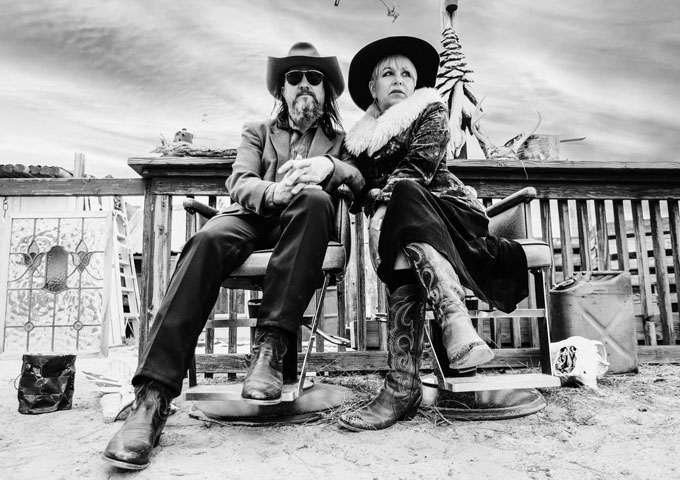
On their new EP, Side Trips, the Mojave Desert husband-and-wife duo breathe fresh emotional life into a beloved composition. With Pat Kearns’ vulnerable vocals and Susan Kearns’ understated upright bass, their interpretation explores the devastating cost of losing yourself in love. Stripped of unnecessary ornamentation, the performance allows every hesitation, fracture, and flicker of hope to resonate. Rather than imitate the celebrated recordings that came before it, the duo finds its own deeply personal connection to the song’s emotional core. The result is an intimate meditation on heartbreak, attachment, and the difficult process of rediscovering yourself.
The most affecting interpretations of familiar songs rarely depend on dramatic reinvention. Sometimes, all a composition needs is the right voice, a sympathetic arrangement, and the courage to leave its emotional wounds exposed. That philosophy guides The Kearns Family through their rendition of “Killing the Blues,” the enduring composition written by Rowland Salley and embraced by generations of performers. Featured on their new EP, Side Trips, the recording approaches a well-traveled song with a striking sense of intimacy, drawing listeners into the uncertain territory between loving someone deeply and realizing that love can leave you feeling painfully disconnected from yourself.
With Pat Kearns on vocals and guitar and Susan Kearns on upright bass, the husband-and-wife duo brings an understated authenticity to material that has become a touchstone for American roots music. “Killing the Blues” has found distinguished interpreters in John Prine, Alison Krauss and Robert Plant, Shawn Colvin, and numerous others, each discovering different shades of melancholy within its deceptively simple narrative. The Kearns Family takes a different path, placing the emotional strain of the song at the forefront and allowing its contradictions to emerge through a sparse acoustic arrangement.
Pat Kearns made a deliberate decision to arrange the song in a key that encourages his voice to break naturally at emotionally significant moments. This choice is central to the recording’s character. Rather than smoothing away every imperfection, he allows the slight instability of his delivery to become part of the storytelling. His voice carries the sensation of someone trying to maintain composure while confronting feelings that refuse to remain neatly contained. It is a performance shaped by restraint, but restraint here does not mean emotional distance. If anything, the vulnerability makes the experience more immediate.
Susan Kearns’ upright bass provides the grounding element that allows this fragile vocal approach to flourish. Its presence supports the song without crowding it, maintaining a sense of movement while preserving the stillness that makes the arrangement so compelling. Pat’s acoustic guitar establishes the intimate framework, and the bass supplies a quiet counterweight, keeping the performance connected to the physical world even as its emotional narrative seems to drift between memory, regret, and resignation.
The lyrics begin with an image of falling leaves illuminated in vivid autumn colors, a scene in which beauty and destruction exist side by side. The leaves resemble embers, suggesting that the landscape itself has caught fire. This is not simply a picturesque description of seasonal change. It introduces a central tension that runs throughout the song: something can be beautiful precisely as it approaches its end, and an experience that once brought warmth can eventually leave behind the sensation of being burned.
The imagery also establishes a dreamlike atmosphere. Natural elements become expressions of an internal emotional state, blurring the distinction between what the narrator sees and what the narrator feels. Love is presented as something capable of illuminating the world while simultaneously making it dangerous to inhabit. In the Kearns Family’s interpretation, Pat’s vulnerable vocal delivery reinforces this ambiguity. The beauty is still present, but it carries the weight of hindsight, as though the narrator can no longer remember the exhilaration without also remembering the damage.
The recurring refrain introduces a more elusive image of apparent freedom. The narrator is described as swinging the world by the tail and bouncing above the clouds, seemingly enjoying an almost impossible sense of liberation while killing the blues. On the surface, these images suggest triumph over sadness. Yet their exuberance sits uneasily beside the song’s underlying sorrow.
That contradiction is essential to understanding the composition. The narrator may appear liberated, but the refrain never entirely resolves the emotional questions raised by the verses. Its buoyancy can be interpreted as a fleeting escape, an attempt to convince others, or even a protective fantasy that makes private suffering easier to conceal. The repeated insistence on this seemingly carefree state gradually becomes more complicated, because the listener knows that the narrator is not simply celebrating freedom. Something has been lost, and the emotional consequences remain unresolved.
The Kearns Family’s stripped-down arrangement gives this contrast room to breathe. Rather than forcing the refrain into an uncomplicated moment of uplift, the duo allows its brightness to coexist with the sadness surrounding it. The performance captures the peculiar experience of appearing fine while carrying an emotional burden that refuses to disappear. Sometimes, the language of liberation is itself evidence of how badly someone needs to escape.
The song becomes even more revealing when the narrator acknowledges guilt. The admission is not framed as a straightforward confession of wrongdoing but as recognition of a deeply unsettling possibility: losing yourself in love can be one of the most painful experiences a person endures. This is where “Killing the Blues” reaches beyond the familiar territory of a breakup song and into something more psychologically complex.
Pat Kearns’ deliberately fragile vocal approach is particularly effective in this context. A polished, technically immaculate performance might communicate sadness, but the natural breaks in his voice evoke the difficulty of speaking honestly when the truth itself hurts. His delivery suggests a narrator who understands the consequences of what has happened without necessarily knowing how to recover from them. That uncertainty gives the recording its emotional credibility.
The final verse introduces another painful contradiction. The narrator is asked to leave, pursue independence, and discover what is needed, yet the requested journey seems to lead toward something already possessed. The implication is quietly devastating: perhaps the narrator has been searching outside the self for something that was never truly lost, or perhaps the relationship has obscured an understanding that was once within reach.
This tension complicates the idea of separation as either punishment or liberation. Leaving may be necessary, but necessity does not make departure painless. Nor does the promise of independence automatically restore what has been damaged. The narrator stands between the desire to remain connected and the recognition that continuing along the same path may mean losing even more of the self.
By returning to its refrain rather than offering a neat resolution, the song preserves that uncertainty. The listener is left to consider whether the narrator has genuinely escaped sorrow, is attempting to outrun it, or has simply learned to carry it differently. The Kearns Family understands the value of this ambiguity. Their interpretation does not explain away the contradictions or turn the narrative into a reassuring lesson about heartbreak. Instead, the arrangement allows the unresolved feelings to remain present, which is precisely why the song continues to resonate.
This sensitivity to complicated lives is characteristic of the duo’s wider musical identity. Based in Landers, California, near the expansive landscapes of the Mojave Desert, The Kearns Family blends high-desert folk, cosmic country, and spare, narrative-driven songwriting. Their music often gravitates toward gamblers, drifters, and brokenhearted figures whose experiences reflect the harsher realities of life. These are not idealized characters whose troubles disappear at the end of a verse. They are people shaped by decisions, disappointments, and the difficult business of continuing forward.
Their debut album, Together and Alone, released in January 2025, established this approach with recordings made live at the couple’s off-grid, solar-powered studio near Goat Mountain. The album’s raw honesty and unmistakable sense of place helped define a sound in which atmosphere never overwhelms the story. The duo’s latest release, Side Trips, extends that musical identity through a collection of previously unreleased recordings and transformed covers that might otherwise have remained without a home. Its unexpected interpretation of ABBA’s “Dancing Queen” establishes an adventurous spirit, while “The Ballad of Bobby Furst,” co-written by Pat Kearns and Will Amato, honors the late Joshua Tree artist and impresario Bobby Furst, who died in 2025. The EP also revisits Townes Van Zandt’s “Nothin’” and Butch Hancock’s “When the Nights Are Cold,” a song familiar to many listeners through Jimmie Dale Gilmore’s recording.
The Kearns Family’s “Killing the Blues” succeeds because it understands that heartbreak rarely follows a straight line. Relief can coexist with regret, love can become entangled with self-abandonment, and the prospect of freedom can feel frightening even when it is necessary. The duo captures these opposing emotions without forcing them into an easy conclusion, creating a performance that feels intimate, lived-in, and quietly devastating.