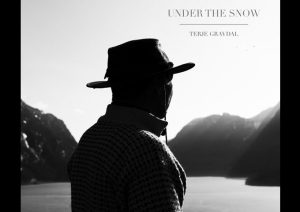
Terje Gravdal Unveils “Under the Snow,” a Haunting Nordic Portrait of Silence and Hidden Truths

A single built on restraint speaks louder than confession. Terje Gravdal opens his sweeping concept album with a song about what stays buried. Snow becomes metaphor, memory, and warning all at once. Produced with quiet precision, the track trades volume for atmosphere. It marks the first chapter of a much larger northern story.
Some artists chase the loudest room in the house. Terje Gravdal builds his instead from the coldest, quietest corner of it, and somehow that choice makes “Under the Snow” one of the more arresting Americana releases to emerge from Scandinavia this year. The Norwegian songwriter, who describes himself as a Northern Observer, has spent his career translating the tension of ordinary lives into something closer to cinema than song. With this new single, the opening track from his forthcoming album Songs of Witness, he continues that project with a piece of writing so controlled, so carefully withheld, that its power creeps up on the listener rather than announcing itself.
Gravdal works at a genuinely interesting intersection: Nordic folk tradition on one side, cinematic Americana storytelling on the other. It is a pairing that should not work as well as it does. Where American folk-Americana tends to lean into dust, highways, and open plains, Gravdal replaces that imagery with fjords, frost, and silence. The result is a sound that feels both foreign and instantly recognizable, a bit like hearing Jason Isbell or the hushed corners of Chris Stapleton‘s catalog reimagined through a Scandinavian winter. Fans of Bon Iver‘s more skeletal, atmosphere-first material will also find familiar ground here, though Gravdal’s baritone gives the songs a gravity that sits closer to the earth than to falsetto abstraction.
“Under the Snow” was produced by David Michelsen and Marius Bergseth, and their fingerprints are everywhere in the song’s discipline. Nothing overreaches. Acoustic guitar lines move with patience rather than urgency, and the string arrangement never swells into melodrama, choosing instead to underscore rather than dominate. It is the kind of production that trusts the vocal to carry the emotional weight, and Gravdal’s voice, resonant and unhurried, repays that trust completely. There is a stoic quality to his delivery that never tips into detachment. He sounds like a man who has watched something happen for a long time before deciding to describe it.
That description is where the song’s real ambition lives. Lyrically, “Under the Snow” builds a portrait of a world governed by appearances, a place where composure functions as currency and where the things left unsaid matter more than the things spoken aloud. Gravdal writes about careful gestures and careful omissions, about paperwork and process moving forward while nothing of substance is actually resolved. There is a recurring sense of transactions happening just out of view, agreements made in soft tones that never quite reveal their true cost. Ambition gets dressed up as concern, and generosity gets repackaged as control. It is a bleak read of institutional behavior, but Gravdal never names an institution, a country, or a conflict directly, which is precisely what gives the song its staying power. He is not writing a protest song. He is writing an anatomy of concealment itself.
The second half of the lyric shifts the scene toward wealth and distance, painting an image of comfortable rooms far removed from the consequences of decisions made within them. Public statements and private realities are shown to diverge, records are kept or quietly discarded depending on convenience, and the pattern the song has been building since its opening lines tightens into something closer to indictment, even as the delivery remains gentle. That contrast between soft musicality and hard subject matter is the song’s defining trick. Gravdal never raises his voice, yet the accumulation of imagery does the shouting for him.
Snow, naturally, is the song’s central symbol, and Gravdal uses it with real precision rather than as decorative scenery. It is the thing that falls silently and covers everything indiscriminately, smoothing a landscape into uniform whiteness regardless of what lies beneath it. In the song’s world, snow becomes a stand-in for institutional silence, for the passage of time that erodes accountability, and for the comforting illusion of purity that hides a far messier reality underneath. The recurring image of something disappearing under snow, only to be described later as clean and perfectly white, functions almost like a chorus of denial, a phrase repeated until it starts to sound like the official version of events rather than the truth.
What makes this especially compelling in the context of Songs of Witness is that Gravdal has stated the album is not interested in taking political positions. Instead, it asks listeners to observe the mechanics of power, language, and memory and draw their own conclusions. “Under the Snow” functions as the perfect overture for that mission. It introduces the snow, wind, and northern landscape imagery that will apparently recur across the album’s ten interconnected songs, setting up a visual and thematic language without tipping its hand toward any specific ideology. That restraint is a genuinely difficult thing to pull off in songwriting, where the temptation to editorialize is constant. Gravdal resists it almost entirely, and the song is stronger for it.
There is also something quietly moving in how the track handles time. References to years passing, quietly and without incident, suggest that the song is not describing a single scandal or a single moment of concealment, but an ongoing condition, something structural and self-renewing. Snow falls every winter. Silence, in Gravdal’s telling, seems to as well.
For listeners who gravitate toward Americana that rewards patience, “Under the Snow” offers plenty to sit with. It is not a song built for immediate gratification, and it does not try to be. Instead, it functions as a slow-burning character study of complicity, comfort, and the particular kind of quiet that only exists when everyone involved has agreed, tacitly, not to ask too many questions. Coming from a songwriter working out of the fjords of western Norway, channeling working-class heritage and Nordic stoicism through the lens of American roots music, that quiet feels earned rather than affected.
As the opening statement of Songs of Witness, “Under the Snow” succeeds on two levels at once. It stands as a complete, self-contained piece of writing, and it functions as a promise of the larger northern chronicle Gravdal is building, one described in terms of system, soil, and soul. Both descriptions feel accurate. Few artists manage to make silence sound this loaded, or make a landscape as simple as falling snow carry this much unspoken weight.
OFFICIAL LINKS: SPOTIFY – INSTAGRAM – FACEBOOK – YOUTUBE – TIKTOK