Limie Dupree Steps Into the Spotlight With “That’s Where I’ll Be,” a Debut Built on Surrender
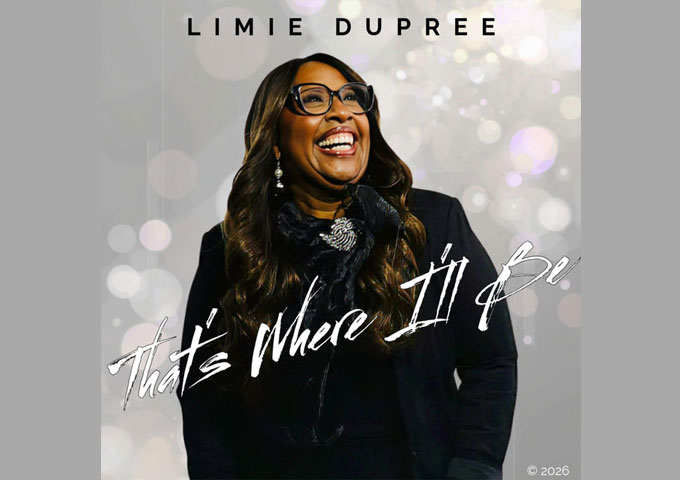
A worship ballad born from a single unguarded moment now carries a message of refuge to listeners everywhere. Gospel newcomer channels a lifetime of ministry into her first commercial release. The song asks a simple question: when everything else falls away, where do you run?
Gospel and Christian recording artist Limie Dupree has officially released her debut single, “That’s Where I’ll Be,” now streaming on all major platforms. For an artist who has spent decades singing in choirs, leading worship, and traveling the globe in ministry, this release marks something different: her first offering under her own name, to a public audience, on her own terms.
The song did not begin as a studio project. It began after a church service, when a handful of people lingered behind and something in the room shifted. Dupree describes the moment as Heaven-inspired, and the description fits. The piano-driven ballad arrived nearly whole, melody and words surfacing together in real time, witnessed by only a few people before it ever touched a recording booth. That origin story matters, because it shapes everything about how the song sounds and what it asks of the listener. This is not a song constructed to hit a chart formula. It is a song that happened to someone, and she simply let it keep happening.
Lyrically, “That’s Where I’ll Be” operates on a single, repeated act of positioning. Across the verses and chorus, Dupree keeps returning to the same physical and spiritual posture: low to the ground, close to the source, unwilling to be anywhere else. The repetition is not a lack of imagination. It is the entire theological argument of the song. Worship music often tries to describe God in expansive, cosmic terms. Dupree does something more intimate. She describes herself instead, and where she has chosen to stand. The song is less a portrait of the divine and more a portrait of proximity, of a woman choosing, verse after verse, to stay close rather than drift.
That choice becomes explicit in the song’s most tender image, where Dupree frames herself as hidden within God rather than hidden from the world. It is an old idea in Christian devotional language, the notion of shelter found not by escaping circumstance but by burrowing deeper into relationship. But the way she delivers it feels conversational rather than doctrinal, almost like an invitation extended to a friend rather than a proclamation offered to a congregation. Come and find me here, she seems to say. I am not hiding from you. I am hiding in the one who made both of us.
The song’s bridge is where the writing opens up emotionally. Fear dissolves, burdens lift, hands rise, and there is a repeated insistence on being made whole in a specific presence. What is notable here is the absence of complaint. Dupree does not catalog what she is escaping from; she never names her troubles directly. Instead, she names only what she is moving toward. That restraint gives the song its emotional discipline. It refuses to dwell in the wound and chooses instead to dwell in the remedy, which is precisely the pastoral instinct you would expect from someone who has spent her adult life as a Praise and Worship Leader rather than simply a performer of praise music.
Musically, the piano foundation gives the song room to breathe. There is no rush toward a big, cathartic key change or a wall of production. The arrangement trusts the lyric and trusts Dupree’s voice to carry the weight, which speaks to a level of confidence uncommon in a debut single. Many first releases lean on studio polish to compensate for uncertainty. This one leans the opposite direction, stripping things back so that the core sentiment, staying close, staying low, staying still, has nowhere to hide.
The closing sections of the song widen the emotional register slightly, naming joy, peace, and satisfaction as things found nowhere else but in that same nearness the song has been circling from its opening line. It ends on an appeal to the Holy Spirit, asking to be undone in presence rather than performance. For a song this quiet, it manages to close on something that feels less like a resolution and more like a continued posture, as if the song never really ends so much as it simply keeps kneeling.
Dupree’s path to this single has been long in the making, even if the recording itself was spontaneous. Born the seventh of thirteen children to Sylvester DuPree Sr. and Annie Mae DuPree, she began singing at five years old alongside her sisters as part of The Starlight Singers, a group shaped under her father’s guidance. That early training moved through school choirs, church choirs, and formal vocal study at the University of Toledo, building a foundation that would eventually carry her into international ministry. As Praise and Worship Leader under Pastors Tony Scott and Shirley Scott in Sylvania, she traveled to Auckland for a Hillsong Church conference and ministered in British Honduras. She has also appeared on the annual telethon for Cornerstone Television Network in Pennsylvania. Today, she continues to serve as Praise and Worship Leader under the spiritual leadership of Pastor Dr. May E. DuPree, balancing musical excellence with what she describes as a prophetic calling.
That background explains why “That’s Where I’ll Be” does not sound like a debut in the conventional sense. It sounds like the first public document of a ministry that has been quietly building for decades. The response since its June 26, 2026 release has reflected that depth. A sold-out release celebration in Toledo kicked things off, followed by strong listener engagement across multiple states, placement on several Spotify playlists, and a debut in the Top 200 of the iTunes Christian chart.
For an artist stepping into commercial release for the first time, those numbers are meaningful. But they are almost beside the point of the song itself, which was never written to chase a chart position. It was written in a room after a service ended, when the only audience that mattered was already there. Everything since has simply been the rest of the world catching up to what that small room already knew. “That’s Where I’ll Be” is available now on all major streaming platforms.