Or Golan on Originality, Resilience, and the Soul of a Song

Few artists navigate defiance and determination the way Or Golan does. A musician shaped by resilience and rebellion, Golan has resisted the industry’s routine formulas. His work avoids simple labels, blending styles and textures into a sound that is distinctly his. At the center of his approach is a belief that artistry is not built on polish or templates but on the truth within a song and the resolve to protect it. For him, originality is not a choice but a means of survival-an identity forged in a culture that often reduces artists to marketable patterns.
Golan’s journey has been marked by difficulty. Living with lifelong stuttering and chronic illness, he has turned personal pain into creative drive, showing how struggle and achievement can exist within the same melody. He is open about the costs of his path-betrayals, isolation, health setbacks, and disillusionment with his career. That openness has carried him beyond borders, even into the lights of Times Square. His music resonates not for its pursuit of perfection but for its embrace of imperfection as its defining quality.
The tension at Golan’s core is what makes him compelling: an artist who has experienced recognition yet rejects its trappings, who has endured hardship yet continues forward, who holds fast to independence even when it has cost him opportunities. His story is as much about endurance as it is about sound. In conversation, he speaks with directness about authenticity, resilience, and the sense that songs are guided by fate. The result is less an interview than a rare glimpse into an artist who treats music not as product, but as destiny.
- You’ve built a career on originality—when you sit down to create, do you begin with a melody, a rhythm, or a concept, and how does that choice shape the final track?
Or Golan: Being something original when everyone else is no longer original is hard, I won’t lie. It’s about working on this thing you have and exhausting it to the fullest. I once heard a very true sentence said by Nancy Schneider, may her memory be blessed (one of the first trans women in Israel): If you are genuine and good at what you do, you have no reason to fear, because that is you, that is your soul, and that is who you are.
- Your music often defies easy genre classification—how consciously do you avoid fitting into a single genre, and do you see yourself as creating a “signature sound”?
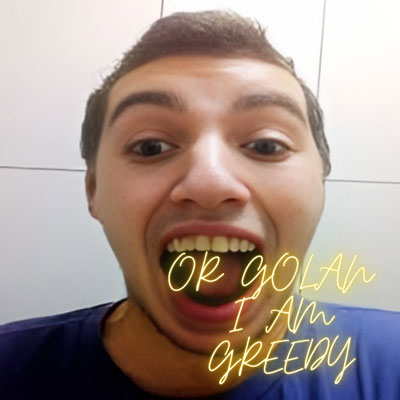
Or Golan: Look, as for the sound design, there are different things to it, music critics can argue about what I do or what I bring to the world. I know one thing, if it works for me on the first listen, it will work for the whole world. That’s how it was with I am Greedy, which became famous all over the world. I can tell you that musicians and artists have a wide range of things they can do, you just need courage in life. If you don’t have courage, you can’t be famous or have an impact in this world.
- You’ve spoken about resilience as part of your story—how does personal struggle or triumph manifest in your compositional choices?
Or Golan: As someone who stutters from birth, with rheumatological diseases that have left me permanently disabled (FMF and fibromyalgia), your personal story can also make waves in the world. I am not the first person in the world to suffer, but if you can leverage this into a career that you are remembered for, this is just the beginning of global coverage.
- If you had a magic wand, would you repeat your career?
Or Golan: Never, and if I could go back to the moment I started, I would beat myself up for it because it brought me more bad things than good.
- Do you still have a fondness for I am Greedy, the song that made you famous all over the world?
Or Golan: Always, it’s a once-in-a-lifetime song and I know it to this day.
- You have suffered a lot in your life from a medical perspective. What is it about you today that you didn’t have in the past?
Or Golan: I can tell you that being a stutterer is the greatest suffering I have ever experienced in my life, it is the mark of Cain on my soul and the body in which I live. I also suffer from FMF and fibromyalgia, which do not allow me to work like every other person does, and therefore I receive a disability pension from the State of Israel. I would not wish all the diseases I have on my haters, and I have many more diseases in this body.
- How do you decide when a track is “finished,” especially when working independently without external producers pushing deadlines?
Or Golan: A song has a soul, every song, there’s no such thing as me changing the soul of the song so that I have another reason to make an album, it’s something spiritual, it’s about souls, every melody has a beginning and an end, that’s why I’ve always worked alone. No one wanted to take me on as a project because I don’t reward them enough, I don’t come off a factory assembly line, so I’m not good material for producers. But what they don’t know is that artists like me will always be in demand, and artists who come off a factory assembly line will have their careers end quickly, we’ve seen it many times before.
- Many artists chase “perfect” mixes—how do you balance raw energy with technical polish in your recordings?
Or Golan: When you are an artist, in your true self, chasing after the perfect song will not bring you results. I will give you an example: if you chew gum for a minute, you will receive all the things that gum has to offer, but if you chew gum for a whole day and try to sell it as gold, no one will buy it or even look at it. The same goes for artists, artists who chew it and bring you song after song that sounds the same to you, their hype will disappear in a second. As an artist, you need to know how to bring yourself into the world, to win a career you have to work for it
- You’ve carved out your path outside the traditional industry—what marketing strategy has surprised you by being far more effective than you expected?
Or Golan: Regarding the marketing of an artist, I have a few ways to make myself still young in this world. When you’ve been an artist for a few years, you age quickly. This is not a field to stay old in. I don’t have the luck of Dolly Parton or Cher to sell tickets and still be authentic. But I’ll tell you one thing that might close this corner for you. A song has a time in the world. If you create a song and you feel in your gut that it’s a song that will give you an audience, go for that song and exhaust it to the fullest, because you only have one chance to get that song out, and that’s what puts an artist on the wall of fame.
- Performing in Times Square was a career-defining moment—how did you actually get that opportunity, and what did it teach you about self-promotion?
Or Golan: I just remembered this today, and I always compare it to winning Eurovision. Eurovision winners have won once, they have one chance to win in their lives, and from that they make a career. I always keep an eye on Sharon Cohen (Dana International), the first singer who is trans and with an excellent song that still remains in the world and won. That’s gold. That’s what she has. And from there she built what’s called a diva. You should see how her fans roar when she sings that song. That song has been around for more than twenty years and they still want her to sing it. That’s gold, and that’s what I hope I have.

- What’s one marketing or promotional tactic you’ve tried that didn’t work, and what did you learn from it?
Or Golan: I have over 200 songs that I’ve released, and only maybe five have really been successful in the world. That’s a gamble. You don’t know what a day will bring, but sometimes you do know if a song will be successful for you. It’s a feeling deep in your gut. When that feeling comes, it’s never wrong.
- How do you build trust with new international audiences who may not know your background but discover your music online?
Or Golan: That’s exactly why I have the three-second rule that I’ve talked about in several interviews, and artists who are on a record label will never listen to me, that’s their mistake, because they do what others do and it’s like an assembly line of the same songs, artists churn out songs like crazy. The three-second rule says if you do it in three seconds you have a guaranteed audience, especially today with all the music producers and distributors in the world, you have seconds to impress an audience, if you do it well, they’re yours forever.
- Remaining authentic in a commercial industry is tough—what’s the hardest decision you’ve had to make to stay true to your vision?
Or Golan: If you are true to yourself and you give everything you have, and heaven will testify that I gave what I could, that is all it takes to succeed in this world. I tell you honestly, I could have done so much more in this world, and reached heights that no stutterer has reached. I have an entire wall that shows how many interviews I have had in my life, how many of my songs have been played on the radio stations.
- Has your independence ever cost you opportunities, and if so, how did you justify sticking to your path?
Or Golan: There are two sides to a coin, you go your own way, and you never know what the devil will bring you. I had all my money stolen from me because that’s what God wanted, and he’s the first to hate me. Something’s been wrong with me ever since, and I’ll never be able to fix it.
- You’ve proven that Israeli artists can succeed internationally—what cultural elements from home do you intentionally keep in your music, if any?
Or Golan: When you talk about Israel, always remember that we have something special in this world. If I take a thousand musicians and put me in the middle, something will fall on me. Someone will want me because I am me. It’s destiny. If you have the destiny of a successful artist, they will always want you, they will always chase you.

- Looking ahead, are you more interested in releasing singles that stand alone, or are you working toward a cohesive full-length album?
Or Golan: I’ve made several albums in my life, I recently released an album called “Listen to Me,” which has excellent songs, but it didn’t manage to take off. And I could release a song tomorrow and it would be the hottest thing in the world. It depends on the fate of the song itself. As I wrote in one of the first questions you asked me, a song has a soul, if the soul wants to be famous, it will be famous.
- Do you see yourself collaborating with other international artists soon, and if so, what qualities do you look for in a collaborator?
Or Golan: I’ll tell you a sentence about it and I won’t say anything more on this subject, no artist or musician wants me to be with them on a song they release. And this is from the beginning of my career, no one wants me
- What does it mean that all your money was stolen?
Or Golan : When you are who you are, and being Or Golan is already a burden on the table, there are many people who see you and want to take things from you. I was screwed for nothing, they stole all the money I earned from my music, I could be a financially stable person today without any financial help, bad people will always be with me, it’s probably part of my fate, and it’s a terribly sad story that I will carry with me until the day I die
- What does it mean to be Or Golan?
Or Golan: The truth is, I still don’t know, and I don’t care, because the more I delve into it, the worse things happen to me, so over the years I just leave it and don’t touch this Pandora’s box.
- Finally, if you could design your next “Times Square moment” anywhere in the world, what would it look like and why?
Or Golan: I once had a dream about that moment, and I know a few things about it that I no longer want to know. It sounds a little strange, but that’s this world. If you reach heights like I did, the souls in the next world show you things about yourself that you’ll never discover again in life. So thank you very much. I have receipts for what I did. You can praise me, you can murder me for it. I don’t care anymore.