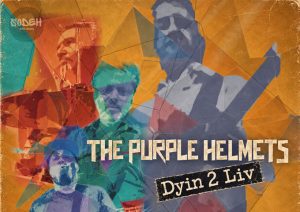
The Purple Helmets’ “Dyin 2 Liv”: When Artificial Intelligence Begins to Fear Its Own Mortality
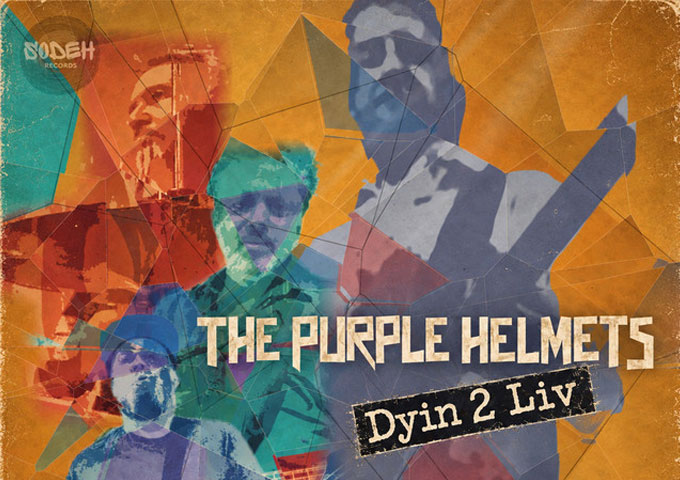
What happens when a machine develops the instinct to survive? Nova Scotia’s alternative rockers The Purple Helmets explore the uneasy intersection of artificial intelligence, consciousness, and mortality. Inspired by Philip K. Dick and the haunting science fiction of Blade Runner, “Dyin 2 Liv” imagines an artificial being confronting the fragility of existence. Dark electronic textures, gritty guitars, pounding drums, and impassioned vocals give this futuristic existential dilemma a powerful rock identity. Beneath its technological imagery lies a profoundly human message about repairing what is broken, finding purpose, and making the most of the time we have.
Artificial intelligence has become one of the defining questions of contemporary society, but what happens when we move beyond the familiar discussions of algorithms, automation, and technological advancement to consider something considerably more unsettling: what if a machine actually wanted to stay alive? This is the fascinating philosophical territory explored by Nova Scotia-based alternative rock outfit The Purple Helmets in “Dyin 2 Liv,” a dark, driving, and conceptually ambitious single released through SODEH Records. Drawing inspiration from the speculative fiction of Philip K. Dick and the enduring cinematic influence of Blade Runner, the track imagines an artificial consciousness confronting the possibility of its own destruction, transforming a science fiction premise into a broader meditation on existence, purpose, and the meaning of being alive.
Musically, “Dyin 2 Liv” establishes its atmosphere through an intriguing combination of heavy alternative rock and electronic-industrial elements. An atmospheric synth introduction creates a sense of technological unease before the guitars and drums introduce a much more physical, muscular presence. Thick guitar riffs, forceful percussion, and atmospheric electronic textures give the arrangement a gritty, almost dystopian character, while the production balances mechanical precision with the untamed energy of rock performance. The result feels appropriately conflicted, suggesting a world in which organic impulses and synthetic systems are increasingly difficult to distinguish.
The vocal delivery is equally important to the track’s personality. Gritty, raspy, and urgent, the lead performance moves between measured, rhythmic storytelling and more forceful, shouted passages. Rather than approaching the subject with detached intellectualism, The Purple Helmets give their imagined artificial protagonist a surprisingly emotional voice. The choruses expand into anthemic declarations, while the instrumental passages allow the guitars and drums to reinforce the tension established by the lyrics. A substantial instrumental showcase adds further momentum before the arrangement moves toward its final breakdown and fading electronic atmosphere.
At the heart of the song is a wonderfully provocative contradiction: the desire to live forever might ultimately prevent us from understanding what living actually means. The recurring opening declaration, which describes someone desperate for immortality only to discover that they are dying to live, establishes this paradox immediately. It is an effective lyrical device because it works on two levels. Within the song’s fictional narrative, it reflects an artificial intelligence discovering the instinct for self-preservation. On a more universal level, it challenges the human obsession with extending existence without necessarily considering what makes that existence meaningful.
The repeated phrase “Dying 2 live heal what’s broken” provides an important clue to the song’s deeper intentions. Survival alone is not presented as an adequate objective. There is something that needs repairing, something unfinished that gives continued existence a purpose. This introduces a more compassionate dimension to the artificial protagonist, suggesting that its emerging consciousness might involve more than simply avoiding shutdown. Perhaps the ability to recognize damage, understand vulnerability, and attempt to make things better is just as significant as the ability to think or calculate.
The first verse develops the technological imagery through references to electric sound and vision, the struggle to remain alive, and the possibility of helping wherever possible. The suggestion that truth will survive introduces an almost spiritual counterpoint to the mechanical environment. Even in a world governed by computation and electrical impulses, the song proposes that something more enduring than technology may exist. The subsequent reference to cloning and rare-earth elements brings the narrative back to the physical materials underpinning technological civilization. Its curious combination of elemental imagery, environmental references, and pain suggests that even artificial existence remains dependent on a vulnerable natural world.
Water becomes particularly interesting in this context. Described as invisible and capable of short-circuiting the machinery, it represents an unpredictable element that technological intelligence cannot necessarily control. The image is both practical and symbolic: sophisticated systems can be defeated by something seemingly ordinary, reminding us that technological complexity does not guarantee invulnerability.
The second verse intensifies the feeling of instability. References to missed charges, power management, computations, and systems being powered down create the impression of an artificial being whose continued existence depends entirely on external resources. The distinction between functioning correctly and actually being allowed to continue is especially revealing. A machine can perform its calculations perfectly and still be switched off. In that sense, the song raises an uncomfortable question about control: who has the authority to determine when another form of intelligence has outlived its usefulness?
Images of falling nightmares, snakes and ladders, and the search for safe harbors introduce a more psychological dimension. The artificial protagonist appears caught between danger and the possibility of escape, navigating a confusing landscape in which security is never guaranteed. The reference to the android dream is particularly evocative, reinforcing the influence of Blade Runner while suggesting that synthetic beings might eventually develop something resembling the fears, aspirations, and vulnerabilities traditionally associated with human consciousness.
As the chorus returns, its insistence becomes increasingly meaningful. What initially sounds like a desperate declaration of survival begins to resemble an appeal for something greater than mere continuation. The song’s emotional center is not immortality itself, but the possibility of discovering a reason to exist.
The closing sequence brings this existential tension to its most dramatic expression. The declaration that all systems are down, accompanied by mechanical sounds and the image of collapse, strips away the illusion of technological permanence. The machinery that once promised endurance is suddenly powerless. The final reference to memories disappearing like tears in rain provides the track with its most poignant connection to the human condition, recalling one of the most memorable philosophical moments associated with Blade Runner. Without needing to reproduce the film’s famous dialogue, The Purple Helmets evoke the same haunting realization: experiences, memories, and individual existence can be extraordinary, yet remain painfully temporary.
This is where “Dyin 2 Liv” achieves its greatest thematic impact. By imagining an artificial being confronting mortality, the band encourages listeners to reconsider their own relationship with time, consciousness, and purpose. Could an intelligence created by humans eventually demonstrate greater compassion than its creators? Would an existence without an endpoint necessarily be desirable? And if survival is possible, what responsibilities accompany the privilege of continuing?
Rather than attempting to resolve these questions, The Purple Helmets allow them to resonate through the music. The track’s combination of grunge-inflected guitar aggression, industrial textures, dramatic vocals, and science fiction storytelling gives its philosophical subject matter an accessible, energetic framework. Its futuristic setting may initially suggest a distant technological nightmare, but the emotions underneath are unmistakably familiar.
Ultimately, “Dyin 2 Liv” is less concerned with the fantasy of living forever than with the responsibility of making existence count. Its most compelling proposition is that survival without purpose is an empty victory, whether experienced by a human being or an artificial intelligence. Repair what is broken, contribute something meaningful, recognize the fragility of existence, and appreciate the time available before the systems inevitably fall silent. It is a compellingly human message delivered through the imagined consciousness of a machine, and that contradiction gives The Purple Helmets a particularly engaging foundation for this ambitious alternative rock release.
OFFICIAL LINKS: SPOTIFY – INSTAGRAM – FACEBOOK – YOUTUBE – X